

Speed limits to increase on some Oklahoma highways
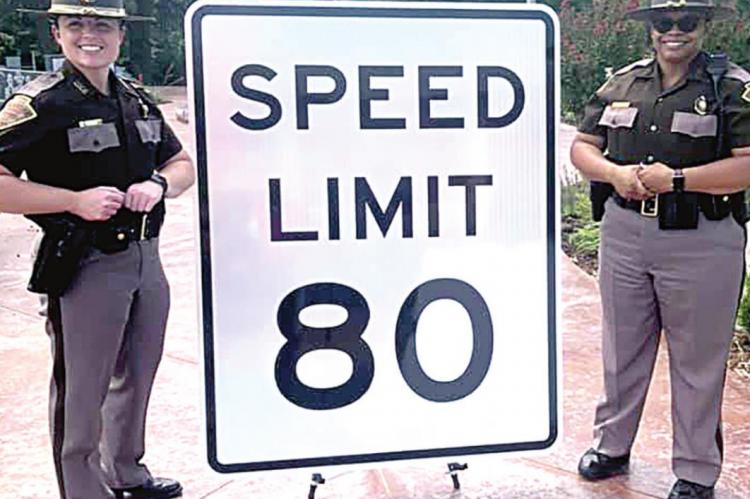
OKLAHOMA CITY — The Oklahoma Turnpike Authority recently raised speeds to 80 mph from 75 mph on rural segments of five existing turnpikes.
The panel also voted to establish an 80- mph maximum speed limit on the Kickapoo Turnpike, which is scheduled to open later this year in eastern Oklahoma County.
The sections of roadway with raised speed limits total 104 miles and include:
• The Turner Turnpike from mile marker 203 to mile marker 216, between Bristow and Sapulpa, 13 miles.
• The Muskogee Turnpike from mile marker 2 to mile marker 33, between Muskogee and Broken Arrow, 31 miles.
• The Cherokee Turnpike from mile marker 3 to mile marker 28, Locust Grove to near Oklahoma 10, 25 miles.
• The Indian Nation Turnpike from mile marker 93 to mile marker 104, between Oklahoma 9 and Interstate 40, 11 miles.
• The H.E. Bailey Turnpike Norman Spur from mile marker 102 to mile marker 107, 5 miles.
• The Kickapoo Turnpike from mile marker 130 to mile marker 149, between Interstate 40 and the Turner Turnpike, 19 miles.
Existing speed limits on rural turnpikes such as the Will Rogers Turnpike, the main segment of the H.E. Bailey Turnpike, the Cimarron Turnpike and the Chickasaw Turnpike will not be changed.
The increased speeds will not become effective until new speed limit signs are posted, which could take several months.
Transportation Secretary Tim Gatz said the new speeds are considered maximums for ideal conditions. If the agency sees unfavorable results, it could ask the OTA to make adjustments downward.
The Oklahoma Transportation Commission met last Monday, and the commissioners approved raising the speed limit on nearly 400 miles of rural interstates. The OTC approved six locations on I-35 and I-40 to change the maximum speed limit from 70 mph to 75 mph and 179 miles of identified rural sections of I-35 and on 220 miles of I-40. These segments include:
* I-35 from the Oklahoma/Texas state line, north 90 miles to just south of the SH-74 junction near Purcell* I-35 from the Oklahoma/Kansas state line, south 89 miles to Waterloo Rd. near the Oklahoma/Logan County line
* I-40 from the Oklahoma/Texas state line, east 32 miles to near the SH-34 junction west of Elk City
* I-40 from just east of the Beckham/ Washita County line, east 22 miles to two miles west of the US-183 junction in Clinton
* I-40 from just west of the Custer/Caddo County line, east 50 miles to just east of Frisco Rd. near Yukon
* I-40 from just east of the SH-18 junction near Shawnee, east 116 miles to just west of the CR 4570 (Dwight Mission Rd.) junction west of Sallisaw.
The recent passage of HB 1071 set the stage for statewide studies on potential maximum speed limit increases of 75 mph on rural interstates and 80 mph on rural turnpikes. Both the Oklahoma Department of Transportation and the Oklahoma Turnpike Authority carefully studied potential locations to be candidates on each of their systems. Criteria was safety-driven and included factors like roadway geometry, sight distance, collision history, traffic flows and existing speed patterns to determine eligible locations. Larger metro areas along interstates such as Oklahoma City and Tulsa were not considered for changes as part of this process but could see changes in the future depending on how drivers handle the current increases. “We appreciate the vision of Rep. Daniel Pae and his fellow legislators to help both agencies take a big-picture look at our system for areas which made sense for a speed limit change,” Oklahoma Secretary of Transportation Tim Gatz said. “We know drivers are looking forward to seeing these changes, and we urge them to do their part for safety by following posted speeds and being alert to the surrounding traffic conditions.” Until the new signs are in place, the old posted speed limits will remain the enforced speed. The Oklahoma Highway Patrol urges drivers to pay close attention to the posted speed limits on their route or risk a ticket. Discussions with safety and law enforcement partners have been invaluable to this process and will be ongoing, especially to help monitor the changes and determine if any adjustments need to be considered for safety. In late July, OTA approved changes for an 80- mph maximum speed limit on rural segments of six turnpikes, totaling 104 miles. Work will be ongoing for several months to manufacture and install new signs in all of these interstate and turnpike corridors.
Commissioners also approved the nearly $880 million County Improvements for Roads and Bridges (CIRB) plan that has been updated for FY21-25. The plan, managed by ODOT, is set to replace or rehabilitate 313 bridges on the county system - of which 151 are structurally deficient or functionally obsolete - and to improve 585 miles of county roads in the next five years. “Oklahoma’s county road network accounts for 60 percent of the state’s bridges and 73 percent of its centerline miles on our state’s transportation system and this funding is fundamental to keeping the ‘off-system’ infrastructure online for years to come,” said Gatz. The plan is comprised of 209 projects with all 77 counties represented. ODOT works with the counties’ eight Circuit Engineering Districts to prioritize projects of the highest need in each county and make the most of state, federal, local and tribal funding sources. The plan allows counties to work together to pool resources to address high-priority projects too large for any one county to accomplish. By law, ODOT administers the plan and partners with the counties to oversee the state and federal funds incorporated into many projects. In the spring, ODOT received a $10.3 million federal grant to replace 34 structurally deficient bridges in Grant County. This Competitive Highway Bridge Grant bundles all the bridges into one project, allowing for more to be done with the same dollar amount through innovative contracting practices. These projects appear in the new iteration of the plan to go to bid in FY21.
Many significant projects across the state are new to the plan this year, including:
* A more than $2 million project to replace a Kingfisher County bridge that was damaged beyond repair in the 2019 spring floods;
* A nearly $4.5 million project to reconstruct a Custer County road that serves as a collector route for I-40 traffic. This project will also improve a railroad crossing; and
* A more than $3 million project to replace a one-and-a-half lane, 600-foot-long McCurtain County bridge with a full twolane structure on a safer alignment to better drivers’ sight distances.
The CIRB Program was created in 2006 by HB 1176 and has proven to be a valuable program to Oklahoma. Since inception, CIRB funds have been involved in nearly $2 billion in construction on the county system. This represents a significant investment to the infrastructure of our state and speaks to the strong partnership between the counties, CEDs, ODOT and many other entities.
A $77 million project to widen I-40 from near Midwest City to Shawnee has been announced by ODOT. The interstate will be widened to six lanes from the Oklahoma-Pottawatomie county line to U.S. 177 in Shawnee-a distance of 7.5 miles. Work on the widening project is expected to start in 2022.
